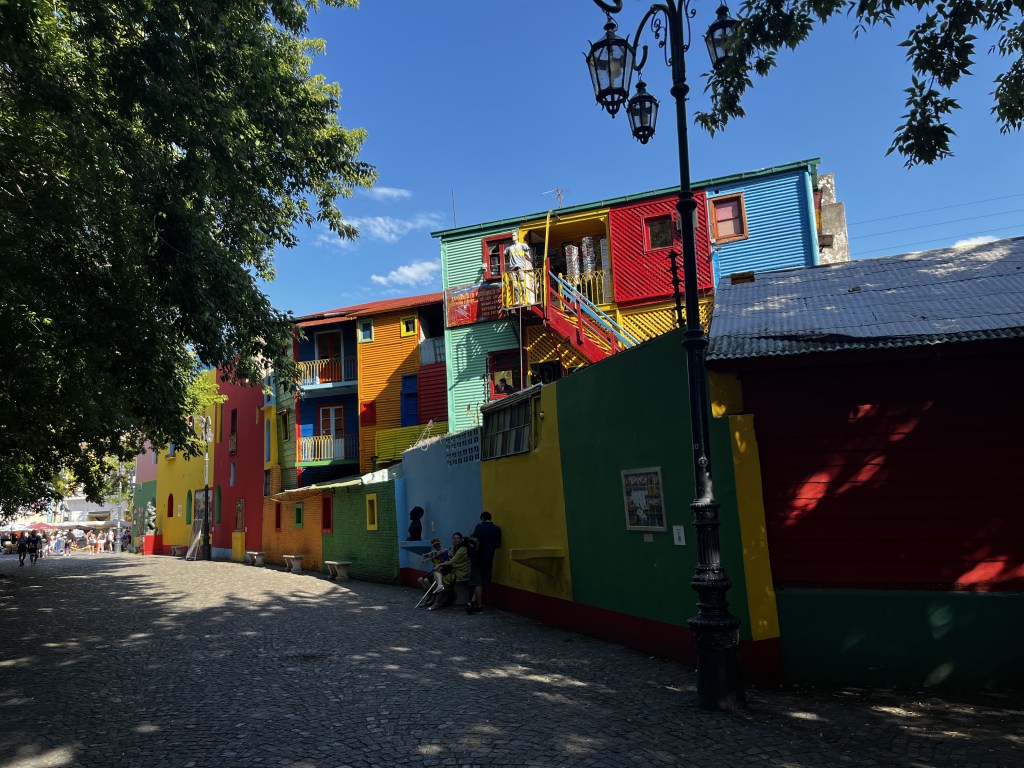
Buenos Aires was our first stop in Argentina. With that said, it included all of the money exchange rate learnings, discovering the national gastronomy and understanding the local rituals.
If you were dropped on one random street in the centre of Buenos Aires, you wouldn’t guess you were in South America. The resemblance to European cities is very clear. The city is relatively “new”, and you can tell that by the architecture, the way green spaces are incorporated into the city and the easiness to move around.
Every corner is full of personality. Argentinians and super welcoming, the vibe is happy and the food is amazing. These are our insights on how to enjoy the city, the food and some practical tips.
What to do in Buenos Aires
We stayed in Buenos Aires for 5 days and enjoyed sunny weather with mild temperatures, which allowed us to walk quite a lot. It is an enormous city so there is a LOT to do. Here is what we were able to fit in:
- Visit the Cultural Centre of Recoleta
- Step foot on the iconic Plaza de Mayo and see Casa Rosada
- Get lost at the open market fair in San Telmo, every Sunday
- Stroll around the gardens of Palermo and Recoleta at sundown, for great people watching
- Visit the Chacarita cemetery – as (or more) beautiful as the Recoleta one. Plus, it is free and here you will find resting the legends of Tango
- Get your Tango on at one of the many Milongas – we visited the well-known La Catedral Club. Symbolic entrance fee and no minimal consumption
- Dance the evening away at the Bomba de Tiempo show, every Monday at Ciudad Cultural Konex – purchase tickets online
- Check out the Ateneo Grand Splendid – a theatre converted into a bookstore and cafe
- Get a glimpse of the Obelisk set in one of the world’s widest avenues
Where to eat in Buenos Aires
In Buenos Aires you will struggle to choose where to eat. There is juicy meat, cheesy pizzas, warm empanadas and sweet dulce de leche everywhere.
Restaurants are full of character and locals and tourists fill up the sidewalks to queue for the delights. Among all of the goodness, here are our top recommendations!
You can get all of these locations of where to eat in Buenos Aires pinned on your google maps with this link
For meat:
- Don Julio, Palermo – any cut of meat. Write your any on the waiting list and indulge in free champagne and empanadas while you (long) wait
- Parrilla el SecreTito, Palermo – bife de Chorizo and provoleta
- Nuestra Parrilla, San Telmo – choripan and Bife de Chorizo on bread
- Desnível, San Telmo – choripan, Empanadas and meats
(Didn’t have the chance to try it, but also highly recommended:)
- La Cabrera, Palermo
- Parrilla el Pobre Luis
- Chori, Palermo – fancier choripan
For pizza/empanadas:
- La Mezzetta, Chacarita
- Imperio, several locations
- El Cuartito, Centro
- Guerrin, Centro
- El Hornero, San Telmo
(Didn’t have the chance to try, but also highly recommended:)
- Togni’s pizza
For international food:
- Sarkis, Palermo – delicious and cheap Armenian food. Arrive early to avoid the long queues
- Sheikob’s Bagels, Palermo
- Nola, Palermo – juicy fried chicken
- Il Ballo del Mattone – Trastevere, Palermo- Italian food
For tradicional Buenos Aires caffes:
- Varela Varelita, Palermo – For the best breakfast medias lunas! Never found similar ones!
- Los galgos bar, Centro
- La poesia, San Telmo
Practical Information when travelling to Buenos Aires
Money exchange
Where should we start… Money while travelling to Argentina is a very long story. We are not experts either, so let’s just lay out the basics we learned. Cash is definitely king, and this is because the rate at which you can exchange currency into Pesos is nearly double the official exchange rate (example in early 2023: 1€=200 Pesos – official rate; 1€=400 Pesos – exchange rate/blue dollar).
To get cash there are two main ways: 1) make a transfer to yourself and retrieve the money in a Western Union office/partner – there are several around the city; 2) if you have dollars or euros, you can exchange money around the city, Florida street has a concentration of exchange businesses. It is possible to bargain the rate too.
At the time of our trip, Visa was also applying a rate 90% of the blue dollar – this is a good option if you don’t want the hustle of the exchange adventure or carrying large stacks of money around.
Moving around
Buenos Aires is probably the most well-connected city we ever visited. There is always, we mean always, a bus from exactly where you are to exactly where you want to go – and best of all, at 0,10€ a ride.
There is also the metro, which is super modern and roughly the same price as the bus.
To use both the bus and the subway you need a SUBE card. This can be purchased at selected metro stations and then charged at any of the many Kioskos around the city.
Both Uber and Cabify are widely available and cheap. Both apps did not accept foreign cards at the time of our visit (early 2023). However, you could opt to pay with Paypal or cash.
There are also urban bikes to rent. Most of the city centre is flat, so you can find yourself walking for hours.
Where to stay
Palermo is the most tourist-friendly neighbourhood to stay in. There are numerous options for hostels and airbnbs at fair prices. Also, this area is booming with restaurants and bars, which means that the streets are full of people at nighttime, making it safer to come back to your accommodation at the end of the day.
When planning ahead consider accommodations in which you can pay in Pesos in cash – this cut your accommodation costs by half.
Safety Tips
We didn’t feel unsafe in Buenos Aires, at all. Use the same precautions as you would in any big city: don’t flaunt, pay attention to your surroundings and know where you are heading.
Data Plans
For data plans, it is better to purchase a SIM card from the local operators. Claro has very affordable plans and they seem to double the offerings every time you recharge your card. You can do so at any Kiosko. The e-sims are much more expensive than the local offerings.
 coolest neighbours
Leave a comment