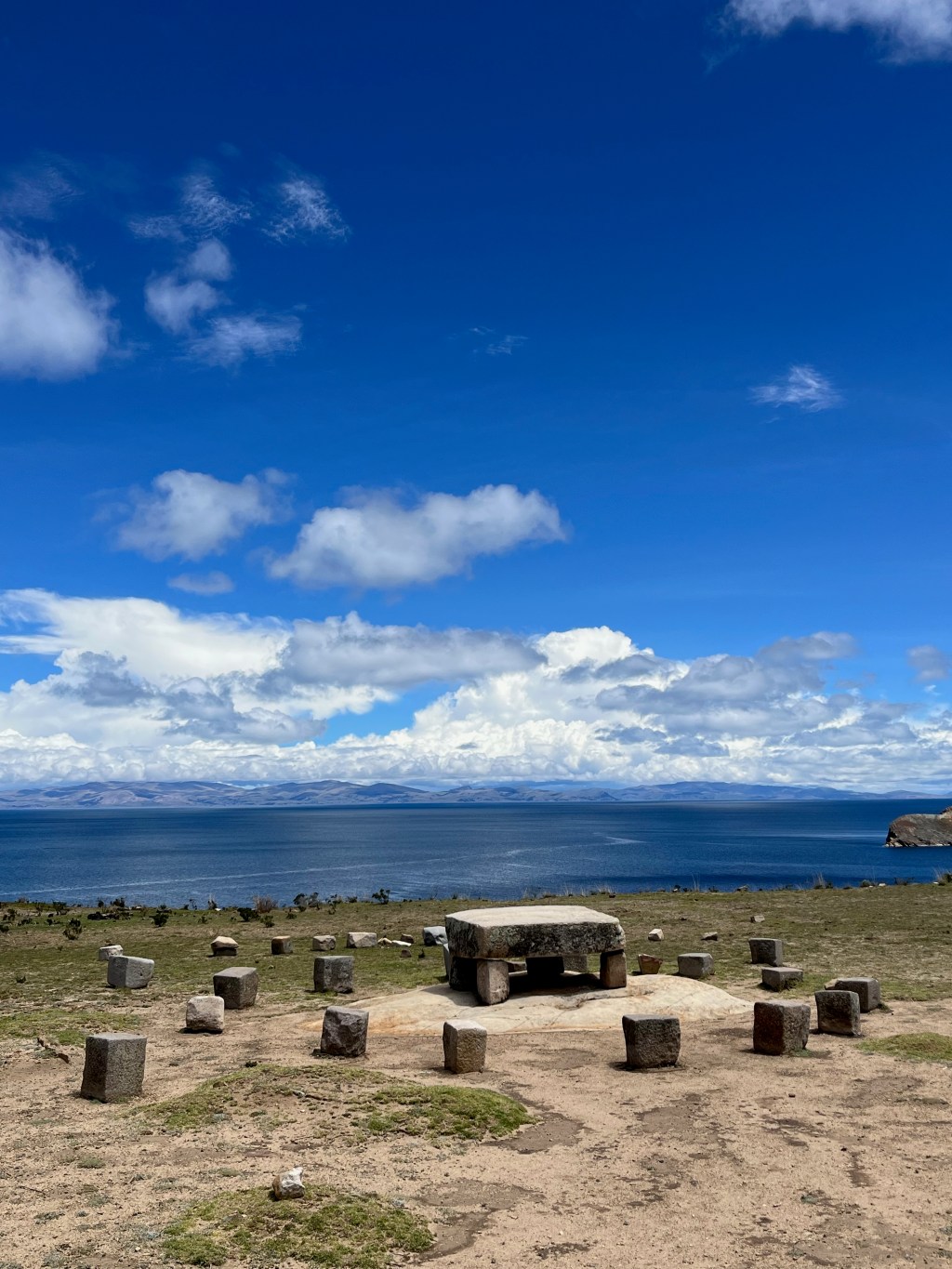
Copacabana is a charming little town overlooking Lake Titicaca, the highest navigable lake in the world. When looking at the lake, it feels surreal to think that you’re actually at 3800 meters above sea level -our minds and noses kept searching for a sea breeze that never showed up.
Isla del Sol in right in the middle of the lake, at a 1:30 boat ride distance and is said to be the mystical birthplace of the Inca civilisation and the place where the sun was born. And at 3800m, with that high altitude thin air, it certainly feels you’re closer to the sun so don’t forget your sunscreen.
How to to get to Copacabana
Getting to Copacabana from La Paz is simple. You just need to catch a bus from La Paz central bus station. It takes approximately 4 hours and cost 30 BOV. Buses are split into tourist and local, the tourist being more comfortable (you’ll hear that a lot in Bolivia). We took a Vicuña Travel bus and it was good. During the ride you’ll have to get out of the bus to take a ferry so bring some extra cash for that. You’ll get off the bus to board the ferry and the bus will take a different ferry and catch you up after the crossing. Be mindful that most (if not all) tourist buses leave early morning from La Paz between 7am and 8am.
What to do in Copacabana
Copacabana is a compact town and most tourists come here as a gateway to either visiting Lake Titicaca and Isla del Sol and/or cross the board to Peru (at the time of writing that was not advisable due to the political situation in Peru). Still, it’s worth spending 1 to 2 days in town. There are some attractions worth visiting here:
- Visit the Copacabana Sanctuary and learn about the story of the Inca prince that became a sculptor
- Go up the lakeside hill at sunset and appreciate the views
- Go biking, busing or walking to the east to appreciate the views and check out some typical villages
However, the biggest attraction for us was just wandering through town (away from the main tourist street where all touristy things are concentrated) and appreciating life going by. In weekdays there are not a lot of tourists but the streets are busy with Cholas (women in typical clothes) selling all types of things and busy local restaurants and street food stalls.
One of our favourite moments in Copacabana was getting though a door at the end of the market and finding a busy cafeteria filled with locals drinking tea, coffee or Api (a hot corn based spiced drink) and eating buñelos (yummy sweets) – try that at the end of the day on fridays or weekends to feel the full vibe.
Generally, eating in Copacabana is pretty cheap if you stick to local restaurants. A set menu (that you can eat for lunch or dinner) costs from 10 to 25 BOV and includes soup (Mani/Peanut is the best), a main and sometimes dessert.
Where to stay in Copacabana
There is a decent hotel infrastructure around town in Copacabana. But if you’re looking for a special experience Las Olas is the way to go. It’s a charming design hotel built by a German sculptor and each room is a work of art. You will also have the opportunity to feed Alpacas in the hotel which makes for a beautiful Andine experience.
Cúpula is also a great choice – the concept came from the same creative mind but it was sold afterwards.
How to get to Isla del Sol
To get to Isla del Sol you will need to catch a boat from Copacabana lake-side “marina”. Tour operators will be shouting “Isla del Sol” all the way from your hotel to the port but it’s just simpler to buy the boat ticket directly at the ticket booth near the lake. The boat leaves in the morning (8:30 the time of writing) and takes approximately 1:30 hours to reach the south of Isla del Sol. You can either seat inside or outside but if you decide to seat outside (the views are nice) make sure to bring some extra layers since it gets cold.
What to do in Isla del Sol
Isla del Sol is a hiker’s paradise – the views are gorgeous and trekking there offers an interesting mix of beautiful nature, typical Aymara communities and pre Colombian ruins.
It’s also high (between 3800m and 4000m) and you will need to be properly acclimatised to the altitude to be able to enjoy your days here.
The best way to experience the island really depends on how long you spend here. You can either come for a day trip (we don’t recommend it – it will feel rushed and you will miss the calming and soothing sunsets) or sleep for 1 or 2 nights. The best place to sleep is in the south of the island. Make sure you come light on luggage (we left most of our stuff in Copacabana) because you will need to go up some very steep Inca stairs as soon as you get of the boat.
We decided to stay for 2 nights and are very happy with our decision. If you’re staying for 2 nights you can do the South Island trek in day 1 – it will take you 2 to 3 hours. In day 2 you can do the trek all the way to the north to the sacred puma rock. Most people take the inland path up north and then come back through the east coast – this is a full day trek (8 hours) and will have a lots of ups and downs. You can have lunch at the one the small towns in the north but bring some snacks along. Day 3 would be the time to catch the boat back to Copacabana.
If you decide to sleep in only for 1 night the best strategy would be to tackle the north on the first day. You can catch a boat directly from the south port to the north and then do the north path just one way down. Day 2 would then be dedicated to the south trek in the morning and getting back to Copacabana in the afternoon.
Most hotels are also restaurants. We really enjoyed Suma Uru and Pachamama where for 25 BOV you will get a set menu of home cooked tasty food that includes soup and a main – mostly milaneza or the ubiquitous trucha (trout).
 coolest neighbours
Leave a comment